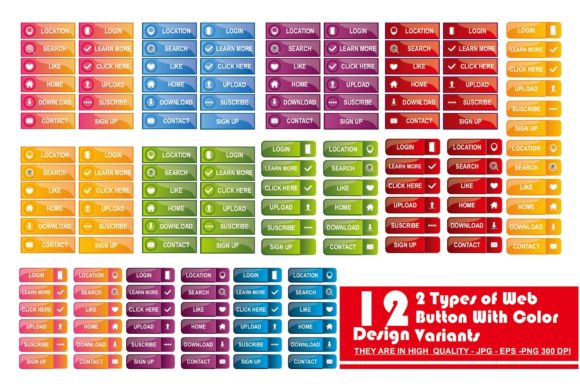
Button Vector for Web with Color Variant: A Practical Asset for Scalable UI Design
In the fast-paced environment of web development and digital marketing, consistency is not merely an aesthetic preference; it is a functional necessity. Users navigate interfaces based on predictable visual cues, and few elements are as critical to conversion and usability as the call-to-action button. This is where a well-constructed Button Vector for Web with Color Variant becomes an indispensable resource for designers, developers, and content creators. Rather than building interface elements from scratch for every project, leveraging a pre-designed, scalable vector set allows professionals to maintain high standards of quality while significantly reducing production time.
The core value of this asset lies in its format and versatility. By providing files in both EPS (Encapsulated PostScript) and SVG (Scalable Vector Graphics) formats, the package addresses the two primary workflows in modern digital design: print-ready or legacy-compatible editing via EPS, and web-native, code-friendly implementation via SVG. The inclusion of multiple color variants further ensures that the buttons can adapt to diverse brand identities without requiring manual recoloring or complex layer manipulation.
The Technical Advantage of Vector Formats
Understanding why vector formats matter is essential for evaluating the long-term utility of this download. Unlike raster images (such as JPEGs or PNGs), which are composed of pixels and lose clarity when resized, vectors are defined by mathematical paths. This means a button designed at 100 pixels can be scaled to 1000 pixels or shrunk to 10 pixels without any loss of sharpness or edge definition. For responsive web design, where elements must look crisp on everything from a smartwatch screen to a 4K monitor, this scalability is non-negotiable.
The SVG Edit File included in this package is particularly valuable for web-focused professionals. SVGs are XML-based, meaning they can be directly embedded into HTML code. This offers several performance benefits: reduced HTTP requests, faster loading times, and the ability to manipulate colors and shapes using CSS or JavaScript. For developers, this means interactive states—such as hover effects or active clicks—can be controlled programmatically rather than relying on multiple image files. The EPS Edit File, conversely, serves designers who work primarily in Adobe Illustrator or similar vector graphics software. It ensures compatibility with older systems and provides a robust foundation for further graphic manipulation before exporting for web use.
Versatility Through Color Variants
One of the most time-consuming aspects of UI design is ensuring that interface elements align with specific brand guidelines. A monochrome button set requires significant effort to customize for each client or project. The Button Vector for Web with Color Variant mitigates this friction by offering a range of pre-configured color options. These variants typically include primary action colors, secondary neutral tones, and alert or success states, covering the fundamental spectrum of user interaction feedback.
This variety supports rapid prototyping. When testing different landing page layouts, a marketer or designer can swap button colors instantly to see which combination yields better visual hierarchy. For instance, a bright orange variant might draw attention for a "Buy Now" action, while a subdued blue variant might be more appropriate for a "Learn More" secondary link. Having these options readily available allows for A/B testing and iterative design without the bottleneck of creating new assets from scratch.
Practical Applications for Professionals
The utility of this asset extends across various professional roles. For freelance web designers, it serves as a reliable component library. Instead of reinventing the wheel for every small business website, they can deploy these vectors as a base, customizing them slightly to fit the client’s logo and palette. This efficiency translates directly to profitability, allowing freelancers to take on more projects without compromising on delivery speed.
Marketers and bloggers also benefit significantly. Many content management systems allow for the insertion of custom HTML or SVG code. By using these vector buttons, marketers can create visually distinct calls-to-action within blog posts or email newsletters that stand out from standard text links. The crisp edges of vector graphics ensure that these buttons look professional even on high-resolution Retina displays, enhancing the perceived credibility of the content.
For educators and course creators, consistency in educational materials is key to reducing cognitive load for students. Using uniform button styles across video thumbnails, slide decks, and learning platforms helps create a cohesive learning environment. The editable nature of the files means that instructors can easily add icons or text labels that match their specific curriculum needs.
Evaluating Quality and Usability
When assessing the quality of a vector asset, several factors come into play. First is the cleanliness of the file structure. A well-made EPS or SVG file should have organized layers, named groups, and no unnecessary anchor points. This organization makes editing intuitive. If the paths are cluttered or the layers are locked and hidden, the time saved by downloading the asset is lost in troubleshooting. High-quality vector sets prioritize clean geometry, ensuring that curves are smooth and corners are precise.
Another critical aspect is flexibility. While the provided color variants are useful, the true test of a vector asset is how easily it can be modified. Can the fill color be changed with a single click? Is the stroke weight consistent? The Button Vector for Web with Color Variant is designed with these considerations in mind, allowing users to decouple the shape from the color effortlessly. This separation of form and style is a hallmark of professional-grade design resources.
However, users should be aware of certain limitations. While vectors are scalable, they are not magic. Complex gradients or shadows included in some vector designs may not render consistently across all browsers if not coded correctly. Therefore, it is advisable to keep the design relatively flat and simple for maximum web compatibility. Additionally, while SVGs are great for icons and buttons, they are not suitable for photographic content. Understanding these boundaries ensures that the asset is used effectively.
Long-Term Value and Workflow Integration
Investing in high-quality reusable assets like this button set contributes to a more sustainable design workflow. Over time, maintaining a personal library of trusted vectors reduces decision fatigue. When a deadline is tight, knowing that you have a reliable, editable button template ready to go can alleviate stress and prevent last-minute compromises on quality.
Furthermore, the dual-format inclusion (EPS and SVG) future-proofs the asset. As web technologies evolve, SVG remains the standard for scalable web graphics. Meanwhile, EPS ensures that if the design needs to be adapted for print media—such as brochures or business cards—the same source file can be used without quality degradation. This cross-media compatibility adds significant long-term value to the download.
In conclusion, the Button Vector for Web with Color Variant is more than just a collection of shapes; it is a productivity tool designed for the modern digital creator. By combining technical precision with aesthetic flexibility, it empowers professionals to build cleaner, faster, and more consistent user interfaces. Whether you are a developer looking to optimize code, a designer seeking rapid prototyping tools, or a marketer aiming to improve conversion rates, this asset offers a practical, efficient solution to a common design challenge. Its value lies not only in what it provides out of the box but in how seamlessly it integrates into a broader, professional workflow.